jueves, 24 de septiembre de 2009

Pizarra Digital Interactivo con wii: version windows xp, vista


If you have windows, an appropriate Bluetooth stack,a wiimote, an ir pen and a projector, you now have an interactive whiteboard. (without the projector, you only have a tablet pc or a really, really, really big virtual wacom-type tablet.) For more in-depth information, I set up a "mind-map" presentation here. Follow the arrow and you can get an overview on the whole process.


(uh, you have your whiteboard as soon as you download THIS SOFTWARE, and make sure you have at least SP 2 (xp only), and the .net 3.5 framework.)

Leave a comment or contact me if you have any questions...

We will be giving a *free* workshop on making this and giving the necessary IR leds to teachers in any schools we perform in.

Good ideas should be spread.
You don't always get better quality paying more.

Two fundamental ideas of Fifth Business.

viernes, 18 de septiembre de 2009

BIS...

Same video just to compare vimeo and youtube now that you can embed in hd...

videos: Artist in Residence

A trailer of the show "Artist in Residence."

artist in residence trailer, www.fifthbiz.com from matt ledding on Vimeo.


An uncut video to show the language content used with these 6 year olds.

5 minutes sin corte from matt ledding on Vimeo.

martes, 8 de septiembre de 2009

Resource: Simple Machines in English

This is a resource for teachers teaching Science in English. An interactive activity that teaches science concepts in simple English words.

domingo, 14 de junio de 2009

Sproutbuilder Back?

SPROUTBUILDER(DOT)COM


A story in past simple:

They offered a great new service to build widgets in flash.
They became very popular.
They suddenly decided they wanted everyone to pay large fees to use their formerly free service.
They lost their user (some would say FAN) base.

This week I received a message from them. They offered me the three free sprouts I had made without charges.

So the free sprouts are back, it seems, for whoever wishes to sign up.

Better not have anything important on them, though, because they seem to change their mind very quickly and that does not fill one with confidence on using their very excellent service. www.wix.com offers a similar service, and don't seem as arbitrary.

In the meantime take a look at both sites to make mini web pages with no programming.

lunes, 8 de junio de 2009

(Sort of) Trading Euros for Dollars.


This is a fantastic program to project onto a whiteboard: it creates a visual background for language.

Imagine dividing the classroom into groups, coming up with strategies to solve the problem, and voting for the most elegant solution. Or in small classes, one person tells another what to do...

You can focus the language at whatever level you are on: conditionals, present simple vs. continuous... whatever. Students should be motivated by the openness of the game to produce language that pushes their boundries of production.

Above all, "Thinking in English" is not one single goal, but two goals. They have to think first... and a memorable visual background with a puzzle to solve is a good hook for memory.

Although a video game is different than a live performance, both projects follow similar principles of visual puzzles, and interactivity, and can motivate and create good memories in English, But... I can't compete with its price. Hmm. Maybe I should delete this entry. (or at least not mention the webpage http://www.crayonphysics.com/)

Or I could offer a discount of 20 euros off the price of our show to any school that buys the program. (at 20 dollars American... )

If you can't beat them, join them.

miércoles, 3 de junio de 2009

miralba


http://miralba.org/archivos/mago_matt_primaria_07.png

Here is another example of performing space, the classic stage.
This is one of the few times I did "Artist on Residence" on a stage... that is... without having the students on the stage as well.

This is the Colegio Miralba, which has a write-up on the show here:


http://miralba.org/archivos/primaria/001336.shtml

They build submarines!


In the Politecnico Cartagena, I had a lovely time.
It is a high school I would have enjoyed: they build fully functional models of submarines, and have made a C3P0 that is an actual working robot. (the link on the title of this entry goes to their web page.)

The staff, as you can see with the English teachers in the photo, are not at all shy, and do an excellent job "in the trenches". (I get to run in for one day, have fun with the students, and avoid the discipline problems and the meetings with angry parents. Que cara tengo.)

In Madrid


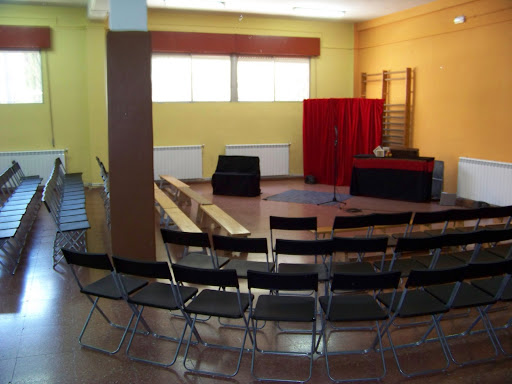
Here is a room with accoustic challenges... a square room and a pillar in the center.

I took the corner, to minimise direct echo, putting students on two sides.
I put the sound as close as possible as the students, and low to the ground.
This kept the echo down as they absorbed the sound.

Perception in Paterna... check out this space.


This is a very well designed theatre space... with the possibility of HORRIBLE acoustics, the walls were corklined and the ceiling lined with cloth. No echo, no need to put myself in a corner to minimize feedback. What a pleasant surprise.

Congratulations to the local administration in making the space so functional.

domingo, 17 de mayo de 2009

How to destroy your marriage making a bad "Speak and Spell"


Ok... I didn't quite destroy my marriage. (I did test my wife's patience quite a bit, though.)

Anyways. Some ideas are better than others.

This is a casiotone keyboard that I rewired to speak the phonetic alphabet.

I wanted to make it speak with juggling balls.

HOWEVER... the problem is that recorded sounds are phonetic, rather than phonemic. (they are mere echos, not meaningful chunks) It is extremely difficult to make a real word sound, let alone a natural sentence. Texas Instruments modeled the vocal chords with their "speak and spell" as seen in "E.T" to make something recognizable, if not very human. I can't put the logic units in without attacking the whole sound puzzle idea I had in the first place. (... and spending a lot of time making a 25 kilo speak and spell. Any programmers rise to the challenge of making some software?)

The good news is, I did invent a new musical instrument that I can play with juggling balls that doesn't merely rely on a sequencer to make the music. (Menendez has one like that... it doesn't matter where he hits, the programming only uses one basic trigger. That is for sissies. It looks really cool, but is for sissies. Sissy, sissy, sissy.)

The bad news is that I need to find time to learn to play and program it... and it weighs a ton. (so that the bouncing balls don't move it.)

I am a firm believer that the quality of a show is shown by the amount of good ideas you throw away making it... and this is an idea that is just "on hold" for a while longer.

Next year, Eurovision will be mine.

Artist in Residence Proyecto.

This is the Artist in Residence didactic guide.
Click on it, and use it like a magazine to read it.


-

miércoles, 13 de mayo de 2009

Teatro en inglés con estudiantes.Drama... mounting a full stage play (2)

If you are looking at doing a theatre project, and need to make stage props, you can get a look at stage design with an excellent, concise book on Design:

Scene Design: A guide to the stage
written and illustrated by Henning Nelms.

This 96 page booklet gives information on creating professional sets on minimum budget, and avoiding common mistakes. You can order it from Dover Publications who change a bit for the shipping from the US, but who sent my last order (which included this book, and a whack of great young learner stuff) in VERY quickly... under a week and a half.

Their bargain bin has some treasures worth digging through as well for young learners or people doing "teatro en inglés" They also have an excellent magic section, including the Bill Tarr book, which is great for age 8-13 (or even adults looking for a base in Magic.)


Gives

miércoles, 6 de mayo de 2009

Michael Swan

Here is the convention I missed... but it has MICHAEL SWAN (yeah!!!) on the panel.

Michael Swan is one of my ELT heros, a very profound thinker, and a very human and interesting person.

His "Good Grammar Book" for students, "Practical English Usage" for teachers and "How English works" are useful, concise, and practical.

There very few videos online of Swan, but here you go, here is what I found.
(Any others?)

On youtube...


on google video, the 2008 TESOL conferance

Part 1, Michael Swan et al, panel discussion.


Part 2, Michael Swan et al, panel discussion.

lunes, 4 de mayo de 2009

Teatro en ingles...

Teatro-Salon.Image via Wikipedia

Here are some scripts for performing theatre in English (teatro en ingles) , downloadable and free. The site is called education world and there are a variety of levels and possible scripts to use in class...

Worth a look, teachers! "Teatro en inglés" is an activity too good to just be left to professionals...
Reblog this post [with Zemanta]

martes, 28 de abril de 2009

Adrian Underhill: pronunciation.

This is a talk that I wanted very much to see, but as I was scheduled at the same time, I missed it at the APAC conference, but you can watch it, in four parts:


here is the first part!


The second part:


The third part:


The final part:


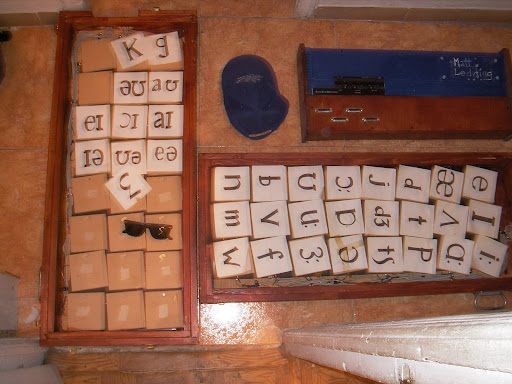
if you want to use phonetic symbols in your work, you can use the online character set at this link:

and of course, I have my way of teaching phonetics:

Preparing for next year's tour! (and reflecting on this year...)

Well, Fifthbiz is going well: we are hiring in the middle of the crisis in Spain, and we are generating a lot of interest.

This year we have:

Performed in almost every province in Spain,
Performed at the TESOL National conference in Sevilla.
Performed at the APAC Conference in Barcelona. (Asociació de profesores de Anglés de Catalunia...)

In addition, I have had time to do corporate work with Vaudeville Negro, teach a class integrating science with language in an English for Biotech Master program, and work on my newest and most important job: being a Dad to the newest team-member, Ana...

Fifthbiz is still evolving, but it is exciting that there is not a traditional hiarchical system: there is no boss. It is like the circus: you are are not higher or lower in position, but only in or out of the circle. Everyone has to look out for everyone else. This creates a bit of chaos sometimes, and we won't ever be a big corporation, but we can take care of each other, and make cool things happen, and that is enough.

Speaking of making cool things happen, I have seen a few resources that might be interesting:

www.teflclips.com - a web page using youtube videos that might be interesting to use with whiteboards, run by Jamie Keddie, a top notch fellow.

I also attended a few talks at the conferences, seeing Michael Swan (a personal grammer hero!)and Scott Thornbury talk about grammar... Elena Bañares Marivela, from Madrid gave an excellent talk about using Ning in the Classroom, that also touched on Hot Potato use, and Annette Capel and Ron Carter gave very interesting talks on Corpus, the Cambridge language database, and Annette's incredibly intensive work at classifying words for levels, and use... a new English in 1000 words? I don't think so...

Jeremy Harmer brought up some interesting points about who "owns" the language, there being now more ESL speakers than Native speakers of English. What I understood, which might not be what he meant, was that the mistakes learners make should not necessarily be corrected, and that we should just accept them as they are. We should not worry about mistakes with irregular verbs, etc.

Swan's rebuttal, or "pre-buttal" as I heard him first in the Barcelona conference, is that there is only one language without irregular verbs: Esperanto, the artificial language experiment. And that the first "native" speakers, the children of the original Esperanto speakers, added a feature to Esperanto: irregular verbs.

Swan suggested that irregular features of a language serve to separate "us" and "them". The implications for me are that Harmer's speech might be great to be more inclusive as native speakers, but as teachers, we have a responsiblity to help our students be as accurate as they need to be. The barrier of "he can't be relevent if he can't even speak right!" of not getting to the content for judgement of the form, or simply, "us" and "them", can exist in many moments. I am sure there are things I don't understand from the speech, but the title phrase of the speech: "ease up on the slap", talking about teen-age English, does more to demonstrate Swan's point than Harmer´s. Teen-agers re-invent their language to make it theirs, and to have a vocabulary that separates them from previous generations. The obstacles that are placed there are a set of hurdles, that if jumped, will win the affection of the native speakers.

With a bit of Spanish, Basque, or Catalan "argot", the listeners often find my frankly dreadful accent charming... because I am trying to imitate something they identify themselves with. It is a way of honouring the listeners, tools that we can give to our students. Accuracy and a more profound understanding of the language and culture shouldn't ever be regarded as "non-trendy".